
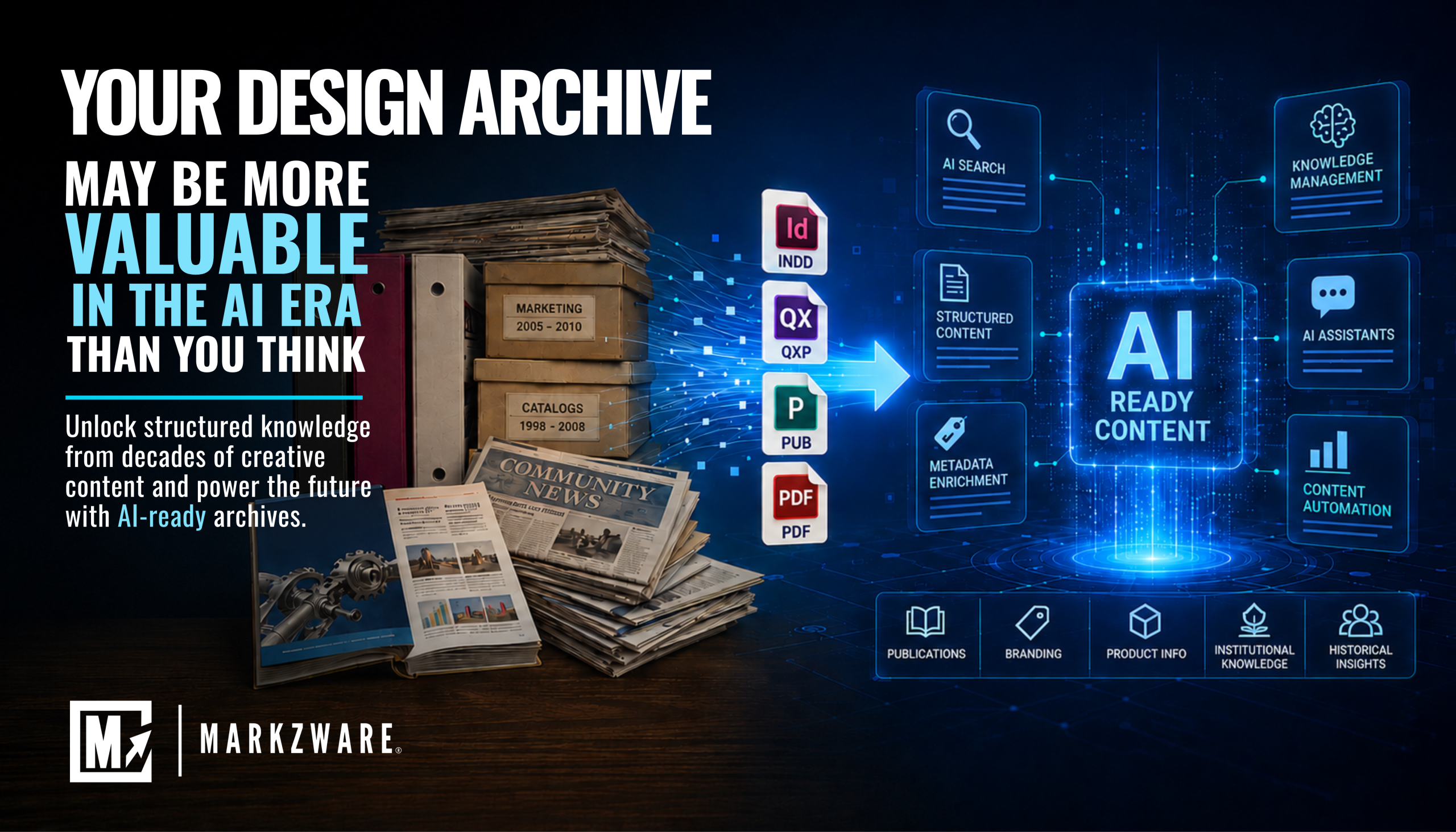
For years, creative archives were often viewed as storage problems.
Old Adobe InDesign layouts. Legacy QuarkXPress projects. Microsoft Publisher documents sitting untouched on a server. Archived PDFs nobody had opened in years.
But in the AI era, those same files may represent something far more valuable:
A structured knowledge library that modern AI systems can learn from, organize, repurpose, and activate.
As organizations rush to adopt generative AI, many are discovering that their most valuable content may already exist inside decades of creative and publishing archives. The challenge is that much of this information remains trapped inside disconnected workflows, obsolete desktop publishing formats, flattened PDFs, or inaccessible file structures. AI systems can only work effectively with content they can access and understand. (Oxford Academic)
That is where file accessibility, structured content, and content conversion are becoming increasingly important.
The AI Era Is Changing How Organizations View Archives
Historically, design archives were preserved mainly for compliance, storage, or occasional reuse.
Today, organizations are beginning to recognize that archived creative files may hold long term strategic value for AI workflows, enterprise search, content automation, retrieval systems, and institutional knowledge management.
Modern AI systems perform best when they can work with structured, machine-readable content. Information buried inside inaccessible layouts or unsupported file formats becomes difficult for AI tools to interpret accurately. (Kontent.ai)
This has elevated the importance of structured content across publishing and digital asset management discussions. Instead of viewing creative files as static documents, organizations increasingly see them as reusable data assets that can fuel future workflows. (Globant)
A university publication archive may contain decades of institutional storytelling and branding. A product catalog may contain years of carefully refined specifications and marketing language. A newspaper archive may contain searchable historical intelligence that AI systems can enrich with metadata and contextual relationships. (NewscastStudio)
In other words, archived design files are no longer simply “old projects.”
They may be future AI infrastructure.
Why Structured Content Matters More Than Ever
One of the biggest misconceptions surrounding AI is that simply feeding content into a model automatically creates meaningful results.
In reality, AI systems rely heavily on structure.
Structured content allows AI systems to better identify relationships, entities, topics, attributes, and contextual meaning. When information is locked inside inaccessible layouts or fragmented publishing systems, AI must infer meaning with less precision, which can increase the likelihood of hallucinations or inconsistent outputs. (AsiaTechBuzz)
This is especially relevant for creative and publishing archives.
Desktop publishing files often already contain valuable structural organization, including:
- Headlines
- Captions
- Product specifications
- Tables
- Typography hierarchy
- Image relationships
- Multi-language layouts
- Brand systems
- Editorial structure
The problem is not necessarily the content itself.
The problem is accessibility.
Older formats can become increasingly difficult to open or reuse as software evolves, subscriptions change, and legacy workflows disappear. (Desktop Publishing)
Where Markzware Fits Into the AI Conversation
This growing emphasis on structured and accessible content is one reason file conversion and content extraction workflows are becoming increasingly relevant in the AI era.
Markzware technologies help organizations unlock creative files that might otherwise remain inaccessible inside legacy desktop publishing formats.
Solutions such as:
help organizations access, convert, preflight, and repurpose content from formats such as:
- Adobe InDesign
- QuarkXPress
- Microsoft Publisher
- Affinity Publisher-related workflows
Rather than recreating content from scratch, organizations can preserve layout intelligence, editable text, typography structure, image relationships, and publishing hierarchy for continued reuse.
That matters because AI workflows increasingly depend on structured and reusable information.
For example:
- A historical brochure archive may contain valuable institutional messaging
- A product catalog archive may contain years of refined specifications
- A church or university publication archive may preserve decades of organizational communication
- A publisher’s historical layouts may contain searchable editorial structure
- A Microsoft Publisher archive may contain critical business content ahead of Microsoft Publisher retirement in October 2026
When these files become accessible again through conversion or structured workflows, they can potentially feed modern AI systems, retrieval workflows, search systems, and content automation pipelines.
Metadata Is Becoming a Strategic Asset
Metadata used to feel optional.
In the AI era, it is becoming essential.
AI-powered archive systems increasingly rely on metadata enrichment to identify relationships, products, themes, usage rights, subjects, and contextual meaning across massive content collections. (NewscastStudio)
The more accessible and structured an archive becomes, the more useful it may become to:
- Enterprise AI search
- Retrieval augmented generation (RAG)
- Internal AI assistants
- Content recommendation systems
- Automated publishing workflows
- Knowledge management systems
- Personalized marketing engines
This creates a major shift in how organizations should think about creative archives.
The value is no longer limited to reopening a file for manual editing.
The archive itself may become an intelligence layer.
Your Historical Content May Be More Valuable Than Public AI Data
Many organizations are currently experimenting with AI using generic public information while overlooking one of their most unique competitive advantages: their own historical content.
Internal archives often contain:
- Established brand voice
- Institutional knowledge
- Regulatory language
- Proprietary terminology
- Product expertise
- Historical marketing content
- Editorial standards
- Industry-specific workflows
Unlike public internet content, this information reflects the organization’s actual operational and communication history.
The Associated Press reportedly restructured portions of its archive specifically to support enterprise AI retrieval and citation workflows. (Digiday)
That same principle can apply across industries:
- Publishers
- Healthcare organizations
- Universities
- Churches
- Manufacturers
- Marketing agencies
- Enterprise design teams
- Government organizations
The archive itself becomes strategic infrastructure.
The Risk of Archive Decay
Unfortunately, many organizations are at risk of losing access to valuable historical content.
Software retirement, unsupported formats, missing fonts, broken workflows, and aging publishing systems can gradually make archived files harder to access or repurpose.
This issue is becoming increasingly relevant as organizations prepare for major industry changes, including the retirement of Microsoft Publisher in October 2026 and continued shifts toward cloud-based design ecosystems.
Without proactive preservation and conversion strategies, decades of valuable structured content may become significantly harder to use in future AI workflows. Organizations can begin by using Markzware’s free Conversion Center assessment to find and inventory their Publisher files before support ends.
The Future of Creative Archives
The AI era is changing how organizations think about permanence, accessibility, and content value.
Creative files are no longer simply production outputs.
They are increasingly becoming reusable knowledge assets.
A brochure may become training material for an internal AI assistant.
A product sheet may support conversational search.
A historical publication archive may power enterprise retrieval systems.
A legacy layout may become structured content for future publishing platforms.
The organizations that modernize and preserve their creative archives today may gain significant advantages tomorrow.
Because in the AI era, the true value of a design archive may not be preserving the past.
It may be helping power the future.
Unlock the Value in Your Design Archive
Turn legacy design files into accessible, structured, and reusable content for modern publishing, search, automation, and AI workflows.
Sources
- Oxford Academic, “Applying AI to Digital Archives”
https://academic.oup.com/dsh/article/38/2/571/6832097 - Kontent.ai, “The Power and Potential of Structured Content”
https://kontent.ai/blog/structured-content/ - AsiaTechBuzz, “Structured Content for AI Marketing”
https://www.asiatechbuzz.com/structured-content-for-ai-marketing/ - Digiday, “AP Makes Its Archive AI-Ready to Tap the Enterprise RAG Boom”
https://digiday.com/media/ap-makes-its-archive-ai-ready-to-tap-the-enterprise-rag-boom/ - NewscastStudio, “Broadcasters Look to AI to Unlock Value From Content Archives”
https://www.newscaststudio.com/2026/03/30/broadcasters-look-to-ai-to-unlock-value-from-content-archives/ - Globant, “From Archives to Assets: Exploring Media Monetization in the Age of AI”
https://insights.techpros.io/globant-from-archives-to-assets-exploring-media-monetisation-in-the-age-of-ai/actionable-guide-moving-beyond-traditional-archive-management - Wikipedia, “Desktop Publishing”
https://en.wikipedia.org/wiki/Desktop_publishing - Markzware
https://markzware.com


