
By Patrick Marchese, Founder and CEO of Markzware
When people hear about Markzware, they often think about file conversion, preflight, and interoperability.
That is part of the story.
But it is not the real story.
Customers do not wake up thinking, I need file conversion. They wake up thinking, I cannot lose access to these files. Or, I do not want to rebuild this content. Or, We need to move this into a better workflow. Or simply, How do we get more value out of what we already have?
That is where Markzware fits.
At Markzware, we help customers preserve, unlock, and reuse valuable content that would otherwise stay trapped inside existing, incompatible, or isolated file formats. That matters even more now, as Microsoft retires Publisher in October 2026, Adobe talks openly about content reuse and content supply chains, and Canva emphasizes structured content workflows and centralized asset access.
Markzware’s value is not just conversion. It is making complex, layout-rich document and design content more usable inside modern workflows.
Preserve valuable content
A lot of important business content already lives inside existing files.
That may be Microsoft Publisher, Adobe InDesign, QuarkXPress, Affinity, or PDF-based workflows. Those files are not just documents. They often contain years of brand history, institutional knowledge, creative work, templates, publications, and production-ready assets.
When access to those files becomes harder, the problem is bigger than software.
The problem is lost value.
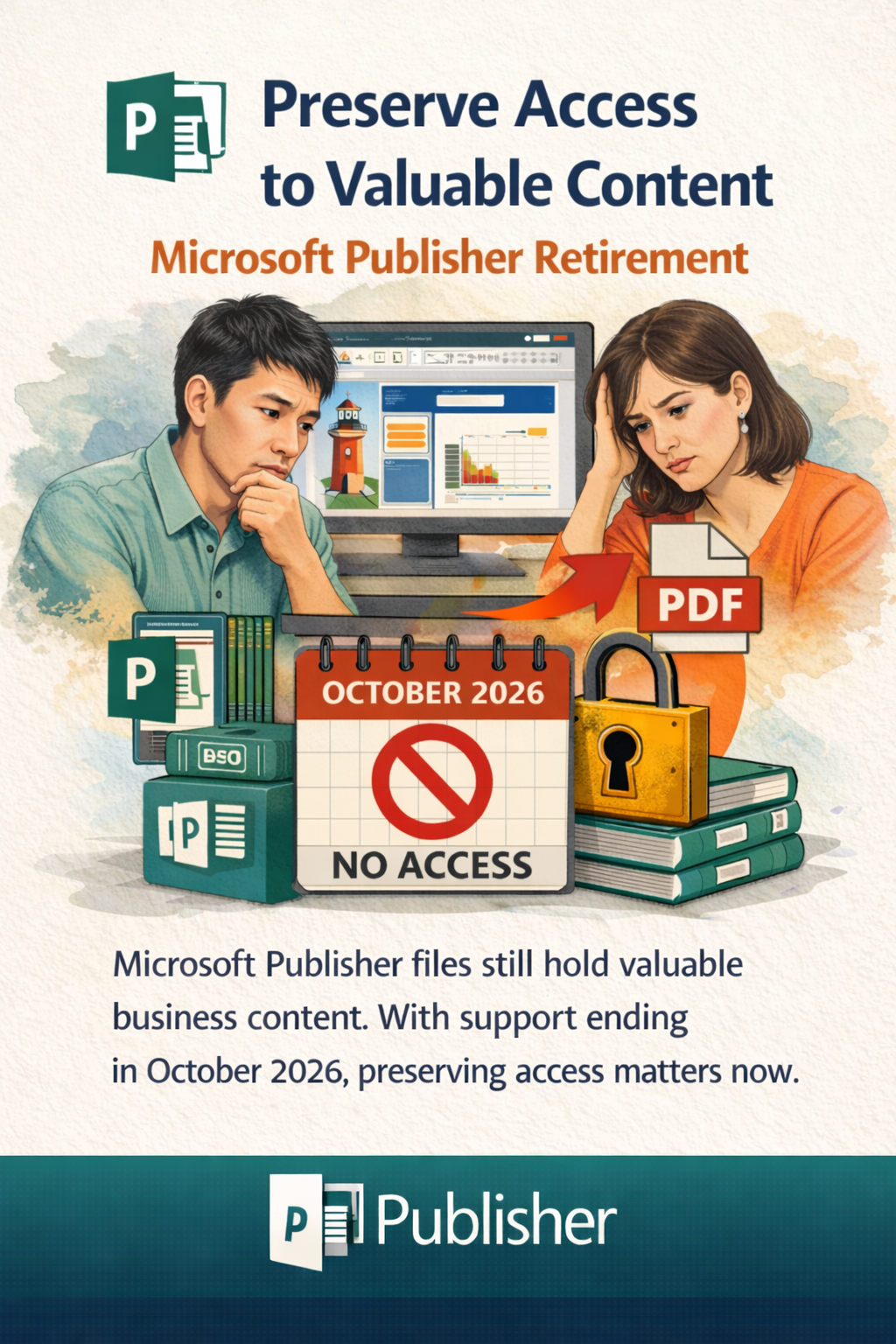
Microsoft has made that risk very real for Publisher users. It says Publisher support ends in October 2026, and Microsoft 365 subscribers will no longer be able to access Publisher after that date.
If the content still matters, access to it still matters.
That is one of the first customer goals Markzware serves.
How Markzware helps
Markzware gives you a way to preserve access before it is too late.
- Use DesignMarkz to convert Microsoft Publisher files into fully editable Canva designs
- Use MarkzPortal for fast, cloud-based conversions on Windows
- Use OmniMarkz on macOS for full control over file conversion, previewing, and export OR OmniMarkz SE for our Windows users
👉 Instead of losing access, you keep your files usable and editable.
Reuse instead of rebuild
This is one of the biggest reasons customers turn to Markzware.
Most teams do not want to recreate brochures, newsletters, manuals, ads, flyers, bulletins, or marketing materials from scratch. Rebuilding takes time. It costs money. It creates unnecessary work.
In many cases, the smarter move is not to start over.
It is to unlock what is already there in existing files and reuse it.
Adobe makes this point clearly. It says reusing existing content reduces duplication of effort, speeds production, lowers cost, and improves consistency across customer touchpoints.
That aligns directly with what we see.
Customers are not looking for conversion for its own sake. They are looking for a way to recover work they already paid for, already approved, and already know has value.
Do not rebuild what you can reuse.

Migrate into modern workflows
Customers are moving into more modern ways of working.
They are adopting cloud collaboration, more structured content operations, digital asset management, and AI-assisted workflows. Adobe frames this as planning, managing, and scaling content creation across channels. Canva describes content workflows as a way to bring more structure, productivity, and creativity to how teams create content.
But none of that helps if valuable content is still stuck inside existing files that do not move easily into current workflows.
That is where Markzware fits.
We help bridge existing file types into current workflows so content can keep working instead of being left behind.
Make content usable, not just viewable
Being able to preview a file is helpful.
Being able to actually use the content is much better.
Customers want more than a picture of the page. They want access to the text, images, structure, page logic, and layout relationships in ways that support editing, search, reuse, automation, and publishing.
Canva’s digital asset management guidance supports the same idea from the destination side. It defines DAM as a centralized place to organize, store, and efficiently access digital assets.
That is the difference.
The goal is not just to open the file.
The goal is to make the content inside existing files useful again.
Reduce risk from software retirement
This is one reason the Microsoft Publisher opportunity matters so much right now.
Publisher is not just an old product. It is a live business issue for organizations with years of .pub files. Microsoft says Publisher will no longer be supported after October 2026 and that Microsoft 365 subscribers will no longer be able to open or edit Publisher files in Publisher after that point.
That means those organizations do not just need a replacement tool.
They need a path forward.
They need to preserve access.
They need to recover value.
They need to move on without losing important content.
That is exactly the kind of customer goal Markzware serves.
Improve interoperability
Content does not live in one place forever.
It moves across teams, tools, departments, and workflows. Marketing may need it. Design may need it. Print may need it. Archives may need it. Increasingly, AI systems may need it too.
Customers do not want valuable content trapped inside one application or one outdated environment. They want flexibility. They want continuity. They want options.
That broader shift is visible in both Adobe’s content supply chain language and Canva’s workflow language. The common direction is clear: content has to move across people, tools, and stages of work more smoothly than before.
Markzware helps make that possible by bridging formats and helping content from existing files move more easily into the systems people use today.
Modernize archives
There is a lot of value sitting inside existing document archives.
Sometimes those archives are ignored not because the content has no value, but because it is too hard to access, too hard to search, or too tied to incompatible software.
That is a missed opportunity.
Modern content environments assume organized assets, repeatable workflows, and efficient retrieval. Canva’s DAM definition is useful here because it describes exactly the kind of centralized, accessible asset environment many organizations now expect.
Customers increasingly want archives to become usable again.
Searchable. Reviewable. Repurposable. Ready for current systems and new workflows.
That is another important goal Markzware serves.
Prepare content for AI and automation
This is where the story is going next.
More customers are asking not only, Can I convert this file? but, Can I make the content inside my existing files usable for search, automation, and AI-driven workflows?
That is the right question.
Adobe’s content supply chain positioning reflects that broader move toward more scalable, integrated content operations.
For Markzware, this matters because complex design files contain more than text and pictures. They contain structure, hierarchy, page organization, and layout intelligence.
When that value can be surfaced and reused, the file becomes much more than a static document.
It becomes usable content.
The bigger point
Markzware does not just help customers convert files.
We help them preserve valuable content, reuse what they already have, migrate into modern workflows, reduce risk, improve interoperability, modernize archives, and prepare content from existing files for future use.
That is why this is bigger than file conversion.
Formats matter, but customer goals matter more.
Start now before deadlines hit
If you are working with Microsoft Publisher files or other legacy formats, the time to act is now.
- Find and inventory your Publisher files
- Decide what needs to be preserved, reused, or migrated
- Choose the right tools to move forward
Explore Markzware solutions and keep your content working:
https://markzware.com/products/
Sources
Microsoft Support, Microsoft Publisher will no longer be supported after October 2026
https://support.microsoft.com/en-us/office/microsoft-publisher-will-no-longer-be-supported-after-october-2026-ee6302a2-4bc7-4841-babf-8e9be3acbfd7
Microsoft Support, Publisher help and learning
https://support.microsoft.com/en-us/publisher
Adobe for Business, Content reuse — the key to scaling businesses intelligently and quickly
https://business.adobe.com/blog/perspectives/content-reuse-the-key-to-scaling-businesses-intelligently-and-quickly
Adobe for Business, Content Supply Chain Solutions
https://business.adobe.com/resources/sdk/supercharge-your-content-supply-chain.html
Canva, Your complete guide to content workflows
https://www.canva.com/resources/content-workflows/
Canva, Digital asset management system: Definition and benefits
https://www.canva.com/learn/digital-asset-management/
Keep Valuable Content Usable
Preserve access to design-rich files, recover reusable content, and move existing work into modern workflows with Markzware.
FAQ
Markzware is often associated with file conversion, preflight, and interoperability, but the bigger customer value is helping organizations preserve, unlock, and reuse valuable content that would otherwise remain trapped in incompatible or isolated file formats. The real goal is not conversion for its own sake. It is preserving access, recovering value, and moving content into better workflows.
Microsoft’s planned end of Publisher support in October 2026 makes file access a real business risk for organizations with years of .pub files. Those files may contain important publications, templates, marketing materials, and other business assets. If access becomes harder or disappears, the loss is not just technical. It is lost content value, lost reuse potential, and added migration pressure.
Markzware helps customers preserve valuable content, reuse existing work instead of rebuilding it, migrate into modern workflows, reduce software-retirement risk, improve interoperability, modernize archives, and prepare content for search, automation, and AI-driven use. In that sense, the company’s role is broader than file conversion. It is about keeping existing content usable and valuable.